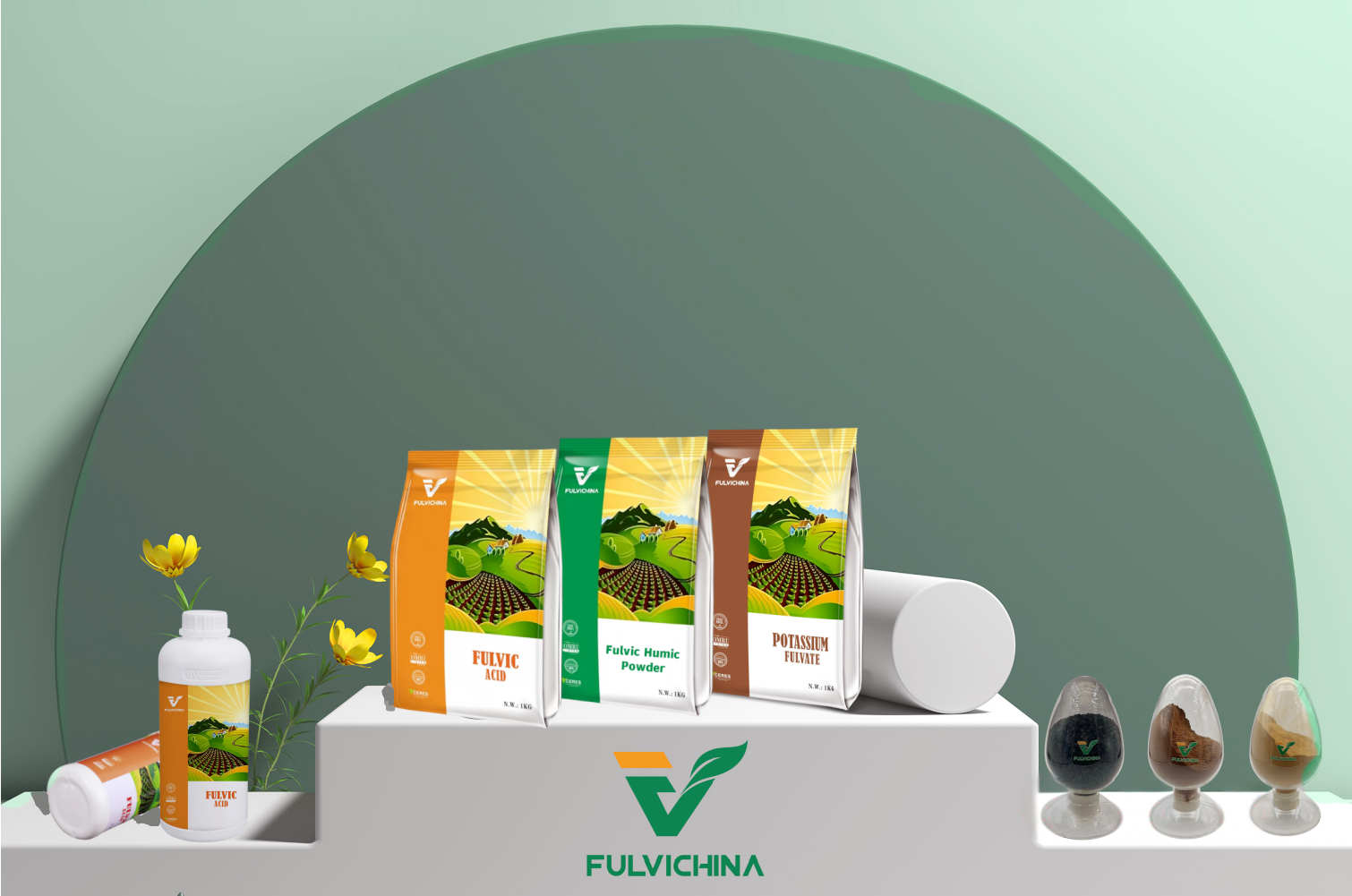
Fulvic acid has drought resistance, stress resistance, disease prevention, growth promotion, soil improvement, fertilizer increase, quality improvement, and enzyme activity enhancement. It has multifunctional functions such as promoting roots and seedlings, increasing chelating ability, and facilitating the accumulation of dry matter.
Main ingredients and physical and chemical properties:
(1) The concentrated liquid is a brown thick liquid with a sauce aroma, specific gravity 1.20-1.4, pH 4.5, solid content in dry matter > 50-70%, fulvic acid 30-50%, effective NPK > 4-8 %, amino acids and nucleic acids >7-10%.
(2) Brown powder, easy to absorb moisture. our fulvic acid powder contains fulvic acid >50-90%. It is also rich in amino acids, indoleic acid, nucleic acids, vitamins, trace elements, etc. It is a multifunctional and highly active product. Fulvic acid-like substances. This product is soluble in any water quality of pH 1-14, does not flocculate or precipitate in high hard water and saturated salt water, and can complex or co-solubilize a variety of metal ions.
1. Scientifically combine new nutrition chains to fully balance plant needs.
In addition to high content of fulvic acid, this product is also rich in almost all amino acids, nitrogen, phosphorus, potassium, various enzymes, sugars (oligosaccharides, fructose, etc.), proteins, nucleic acids, humic acid, VC, VE and a large amount of B vitamins required for plant growth. It is a green biological fertilizer.
2. Growth-promoting factors with high biological activity.
Practice has proved that the core of fulvic acid contains unknown growth-promoting factors with high biological activity. Strictly speaking, fulvic acid does not contain hormone substances, but during use, it shows similar effects to chemically synthesized auxins, cytokinins, abscisic acid and other plant hormones, and plays a comprehensive regulatory role in plant growth and development. Manufacturers who can use this product as foliar fertilizer and flushing fertilizer can replace or partially replace synthetic hormones such as gibberellins, sodium nitrophenolate, and paclobutrazol.
3. Strong chelating ability to improve the absorption and operation of trace elements in plants.
Since fulvic acid has a high content of active groups such as carboxyl and hydroxyl groups and has oxygen-containing functional groups, there are many organic chelation sites and complexation sites in its structure. These coordination groups can react with insoluble trace elements (Ca, Mg, Zn, B, Fe...) to form a complex or chelation reaction, using fulvic acid molecules as intermediary carriers to coordinate and promote the absorption and movement of trace elements and phosphorus in the body by plant roots or leaves.
4. Anti-flocculation, buffering, good solubility, and strong interaction with metal ions.
The limit value of flocculation of fulvic acid is greater than 32meq/g. Its anti-flocculation ability is significantly higher than that of humic acid and similar products. It can be dissolved in any acidic or alkaline water with a pH of 1-14. It flocculates without precipitation in high calcium and magnesium hard water saturated salt water, and has good stability and strong electrolyte resistance. Fulvic acid has good water solubility, exchange with metal ions, and has strong complexing ability.
5. It has significant functions of cold and drought resistance.
The drought and cold resistance mechanism of fulvic acid is: first, it stimulates the activity of enzymes in plants, regulates and catalyzes the cells in plants to accelerate the absorption of water and nutrients, and reduces the water potential of leaves, enhances osmotic pressure and other metabolic activities, so as to stimulate plants to physiologically adapt to the drought and cold living environment. Second, it inhibits the accumulation of K in guard cells. When plants encounter drought and cold, they can improve their water retention capacity, close the stomata of leaves or reduce the opening degree, and reduce water transpiration.
A large amount of experimental data proves that humic acid can significantly increase the stomatal diffusion resistance of leaves by 1.5 times, while reducing the transpiration intensity of leaves by more than half. After spraying, the drought and cold resistance effect can be maintained for about 20 days. Increase soil moisture content and enhance root activity. After spraying, leaf transpiration is reduced, soil moisture content is significantly increased, and the moisture content at different soil depths can be increased by 7%~35%, while soil moisture consumption is reduced by 8% within 10~20 days after spraying. At the same time, the root system is well developed, the number of new roots increases by one quarter, and the root activity increases by 30%, which is beneficial to the plant's absorption of water and nutrients, thereby increasing crop yields and improving crop quality.
6. Small molecular weight.
The average molecular weight of fulvic acid is 300. Its high biological activity makes it extremely permeable to the barrier of plant cell membrane. Through its multiple functions such as adsorption, conduction, transport, bridging, sustained release and activation, it enables plant cells to absorb more water and nutrients that were originally inaccessible. At the same time, it transports carbohydrates, proteins, sugars and other nutrients accumulated and synthesized by photosynthesis to the fruit to improve quality and increase yield.