

Organic Fertilizer Potassium Humate Granular for Palm Tree
| Items | Standards |
| Water Solubility | 99%-100% |
| Humic Acid (dry basis) | 65-70% |
| Fulvic Acid (dry basis) | 1-3% |
| K2O (dry basis) | 10-12% |
| Moisture | 15%max |
| PH Value | 9-11 |
| Particle Size | 2-4mm/1-2mm/0-1mm |
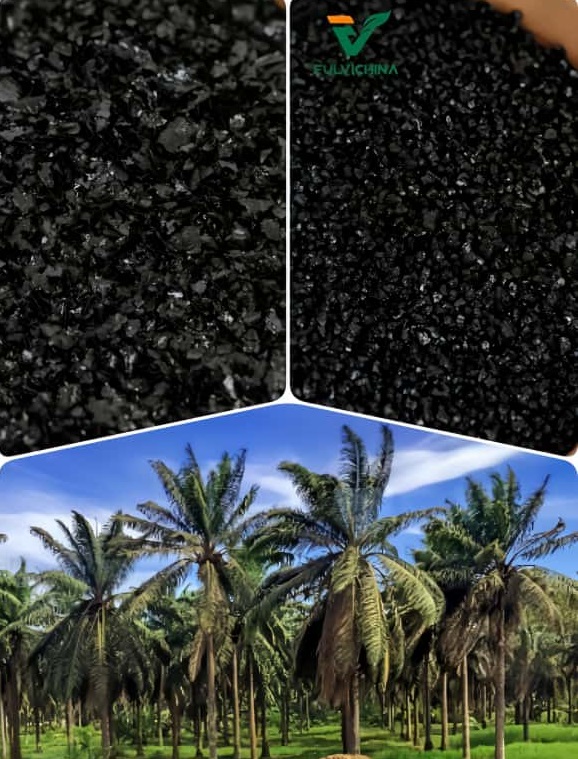
1. Improve soil physical and chemical properties, creating a favorable root environment:
2. Promotes nutrient absorption and utilization (chelation and synergistic effects):
Chelation: Humic acid is a natural organic chelating agent that combines with metal cations in the soil (such as trace elements like iron, zinc, manganese, and copper, as well as calcium and magnesium) that are difficult for palm trees to absorb directly, forming water-soluble complexes. This makes them more easily absorbed by the roots, effectively preventing and alleviating common nutrient deficiencies in palm trees (such as magnesium and boron deficiencies).
Improves fertilizer utilization: Humic acid reduces nitrogen fertilizer volatilization, phosphorus fertilizer fixation, and potassium fertilizer leaching, allowing applied fertilizers (especially potassium fertilizers) to be more effectively absorbed and utilized by palm trees. The potassium (K₂O) it contains is also a macronutrient essential for palm tree growth.
3. Stimulates root growth and enhances tree vigor:
Promotes root development: Humic acid stimulates palm tree root cell division and elongation, inducing the development of lateral roots and root hairs, significantly increasing root length, density, and vitality. A strong and healthy root system is the foundation for palm trees to absorb water and nutrients, support their massive crowns, and withstand adversity.
Enhances Physiological Metabolism: Humic acid can increase the activity of various enzymes in palm trees, promoting metabolic processes such as respiration, photosynthesis, and protein and nucleic acid synthesis, thereby enhancing tree vigor and promoting stem and leaf growth.
4. Providing Essential Potassium:
Potassium is one of the most critical nutrients required by palm trees. Especially for fruit-bearing palms like oil palm and coconut palm, potassium is crucial for ear development, fruit enlargement, oil synthesis and accumulation, and increased oil content/copra yield.
Improving Yield and Quality: Adequate potassium supply can significantly increase ear number, fruit weight, and total yield, and improve fruit quality (e.g., oil quality).
Enhancing Stress Resistance: Potassium enhances palm trees' resistance to lodging (important for tall coconut trees and heavy-bearing oil palms), drought and cold tolerance (in certain marginal planting areas), and resistance to pests and diseases.
5. Enhancing Palm Tree Stress Resistance:
Drought Resistance: By improving soil water retention and promoting deep root development, it enhances palm trees' ability to absorb water during droughts. Humic acid itself can also regulate the opening and closing of plant stomata, reducing water loss through transpiration.
Disease Resistance: A healthy soil environment and strong tree vigor inherently increase resistance to soil-borne diseases (such as ganoderma and seedling blight) and foliar diseases. Humic acid can also induce systemic resistance in plants.
Mitigation of Salt/Acid Damage: As mentioned above, its buffering and chelating properties help protect root systems under adverse soil conditions.
6. Enhancing Soil Microbial Activity:
Humic acid is an excellent"food"source and substrate for soil microorganisms (bacteria, actinomycetes, fungi, etc.). A healthy microbial community accelerates the decomposition of organic matter, promotes nutrient cycling (such as nitrogen fixation, phosphorus and potassium solubilization), inhibits soil-borne pathogens, and creates a soil microbial ecosystem more conducive to palm tree growth.


